
Printscene — Somercotes, Alfreton, Derbyshire
Exterior Business Signage: Types, Materials and What to Expect When You Order
Exterior business signage is the most visible investment most businesses make in their premises. Done well, it pulls attention from the road, builds brand recognition in your local area, and tells passersby exactly who you are and what you do — all without any ongoing cost beyond the initial installation.

Written by Printscene
- Fascia signs
- Projecting blade signs
- Building graphics
- Sign materials for UK weather
Done badly — or not done at all — it leaves potential customers walking straight past, unsure whether you’re actually open or professional enough to be worth trying.
This guide covers the main types of exterior business signage, what each one is best suited to, the materials that stand up to UK weather, and what the ordering process typically looks like.
What counts as exterior business signage?
Exterior signage covers any sign or graphic that’s attached to or displayed on the outside of a building — everything from the name above a shop door to large-format graphics applied to a building facade or estate sign at the entrance to a business park.
It’s a broad category, and different types of exterior sign serve different functions. Some are primarily about identification — telling people the name and nature of the business. Others are about visibility from a distance — pulling attention from road traffic or pedestrians approaching from further away. Some do both.
Understanding which problem you’re trying to solve — or which combination of problems — helps determine which type of exterior signage makes sense for your premises.
The main types of exterior business signage
Fascia signs
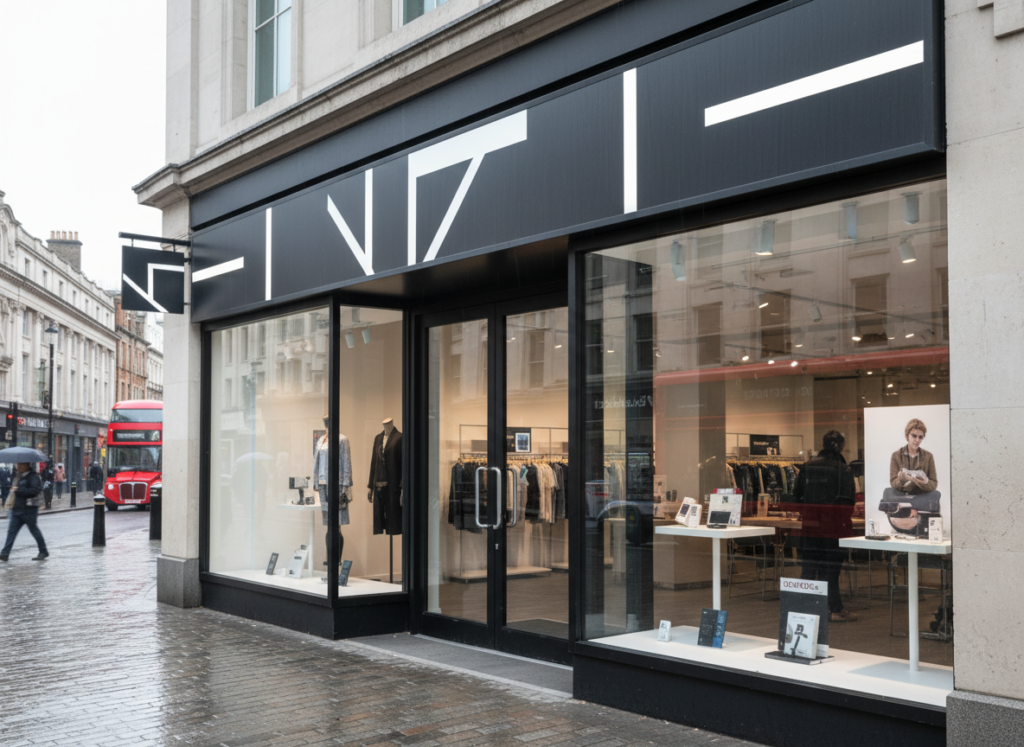
A fascia sign sits flat against the front of a building, typically above the shop window or entrance. It’s the most common form of exterior business signage for retail, hospitality and service businesses on high streets, retail parks and trade estates.
Fascia signs are usually made from aluminium composite panels or built-up letter systems. They can be printed flat or dimensional, non-illuminated or backlit with LED strips. The size is determined by the width of the frontage and any local planning restrictions. For a standard single-unit retail property, a fascia sign is often the most cost-effective and impactful exterior sign available.
Projecting signs (blade signs)
Projecting signs extend perpendicular to the wall, like a traditional pub hanging sign. They’re visible from both directions along a street, which makes them particularly valuable for businesses on pedestrianised areas, narrow streets, or anywhere the frontage isn’t directly visible from the main direction of foot or vehicle traffic.
These are also sometimes called blade signs. They’re available in a wide range of shapes and sizes — from simple rectangular panels to custom profile cuts — and can be illuminated. In conservation areas or heritage buildings, traditional swing signs on brackets are sometimes more appropriate than modern aluminium options.
Post-mounted and freestanding signs
When a business is set back from the road — an office behind a car park, a workshop on an industrial estate, a hotel at the end of a driveway — the building itself may not be visible at the point where the decision to turn in needs to be made. Post-mounted signs solve this.
They range from single-post monolith signs (a solid rectangular panel on a post or plinth) to double-post entrance signs spanning the entrance to a business park or estate. They’re usually made from aluminium composite, acrylic, or built-up foam letters on a timber or metal substrate, and can include illuminated elements.
Building graphics and large-format wall signage
For buildings with large wall areas visible from a road or public space, full-surface building graphics or large-format printed panels can create significant visibility at a distance that fascia signs simply cannot match.
These can be printed vinyl applied directly to render or brickwork, aluminium composite panels fixed to the wall, or painted-look digitally printed graphics. The effect depends heavily on the building material and surface preparation, but when done properly it’s one of the most attention-commanding forms of exterior signage available.
Window graphics and frosted vinyl
Window graphics are technically part of the exterior of a building and can serve as signage in their own right — particularly for ground-floor units where large glazed frontages offer significant display space. Perforated vinyl, printed frosted vinyl, or cut vinyl lettering can all be applied to glass to carry business names, brand messages, opening hours, or promotional content.
Unlike other forms of exterior signage, window graphics can also be updated relatively easily when messaging needs to change, making them useful for seasonal promotions or businesses that rebrand periodically.
Temporary and event exterior signage
PVC banners, mesh banners and pull-up banner systems are also used in exterior settings, particularly for events, temporary promotions, construction site branding, and new business launches. These are not permanent installations but serve a genuine exterior signage function during the period they’re displayed.
Materials for exterior signage: what holds up in the UK
The UK’s weather — wet for much of the year, with occasional extremes of temperature and UV in summer — puts real demands on exterior sign materials. What looks good indoors or in a protected environment will not necessarily last outdoors.
Aluminium composite (Dibond)
The most widely used substrate for exterior signs. Lightweight but rigid, it won’t rust, holds print well, and tolerates years of outdoor exposure without degradation. Used for fascias, post-mounted signs, building panels and sign faces. Can be routed, bent and powder-coated. The standard choice for most commercial exterior sign applications.
PVC foam (Foamex)
A lighter, lower-cost option suitable for protected exterior positions — signs under a canopy, temporary installations, or short-to-medium term display. Not recommended for exposed positions where it’ll take direct rain and UV over multiple years. Good for signage that needs to be updated regularly.
Exterior-grade vinyl
Vinyl applied to surfaces — buildings, windows, vehicles — should be exterior-grade cast vinyl for any permanent or long-term outdoor application. Calendered vinyl can be cheaper but is less conformable and has a shorter outdoor lifespan. Quality exterior vinyl typically carries a 5–7 year guarantee against fading, peeling and shrinkage.
Acrylic (outdoor grades)
Cast acrylic in outdoor grades is UV-stable and holds its clarity and colour well in exterior conditions. It’s used for illuminated sign faces, built-up letter shapes and dimensional sign elements. Cheaper acrylic products can yellow and become brittle in UV, so specifying the right grade matters for anything going outside permanently.
A reputable sign printer will automatically specify appropriate materials for your intended installation — if they’re not asking where the sign is going and whether it’ll be exposed to weather, that’s a prompt to ask the question yourself.
Planning permission for exterior signs
In the UK, many exterior business signs are covered by “permitted development” rights, which means they can be installed without a formal planning application. However, this is not universal — certain types of sign, certain sizes, certain locations, and certain building types require express consent from the local planning authority.
Signs that are most likely to need planning permission include:
If your premises is in a conservation area, listed building, or near protected spaces, check with your local planning authority before commissioning signage. Most local councils have a planning portal where you can check the status of your property and find the relevant guidelines.
Note: Printscene can advise on signage types and dimensions that typically fall within permitted development, but formal planning guidance for your specific property should always come from the relevant local planning authority.
What to expect when ordering exterior business signage
Exterior signage is a bigger investment than most other print products, and the ordering process tends to reflect that — it involves more back-and-forth than ordering a set of business cards or a banner.
Initial consultation and site details
The first step is usually a conversation about what you need and where it’s going. Key information includes the dimensions of the space the sign needs to fill (or the maximum size that would work in context), the building material the sign will be fixed to, whether it needs to be illuminated, and any planning considerations you’re aware of.
For larger or more complex installations, a site survey or visit is often worthwhile — either by you providing accurate measurements and photos, or in some cases a printer visiting the site to assess the space directly.
Design and proof
Once the specification is agreed, a design or print-ready artwork file needs to be confirmed. If you have an existing brand with logos and colour references, provide these at the outset. If you need design work from scratch or have artwork that needs adapting for the sign format, this will be arranged before production begins.
A proof — either a digital visualisation or a physical print sample — should be approved before the sign goes into full production. On any sign that involves significant cost or custom fabrication, this is not a step to skip.
Production and installation
Production timescales for exterior signs vary considerably based on complexity. A straightforward flat-panel fascia sign can often be produced in a few days. A built-up letter system with LED illumination will take considerably longer. Confirm timescales clearly before ordering, particularly if you have an opening date, an event, or a planning approval deadline to meet.
Installation may or may not be part of the service your printer offers. Some print and sign companies install directly; others supply the finished sign ready for a signage installer or general contractor to fit. Confirm this before ordering to avoid a situation where the sign is ready but there’s no one to put it up.
Maintenance and longevity
Well-made exterior signage using appropriate materials should last five to ten years with minimal maintenance. The primary maintenance tasks are periodic cleaning (a gentle wash with soapy water is usually enough), checking fixings after severe weather, and replacing any lighting components that fail over time.
Vinyl-based signs have a shorter lifespan in exposed positions than rigid aluminium signs and may need replacement sooner. When getting a quote, ask about expected lifespan for the specification being proposed.
Exterior signage: key types at a glance
| Sign type | Best suited to | Typical material |
|---|---|---|
| Fascia sign | Retail units, high street businesses, offices with frontage | Aluminium composite, acrylic, built-up letters |
| Projecting / blade sign | Narrow streets, pedestrianised areas, hospitality | Aluminium composite, acrylic, illuminated face |
| Post-mounted / monolith | Business parks, set-back premises, car parks | Aluminium composite, acrylic on post or plinth |
| Building graphics | Large-format visibility, warehouse units, roadside | Exterior cast vinyl, printed aluminium panels |
| Window graphics | Glazed frontages, retail, offices, promotions | Exterior cast vinyl, perforated vinyl, frosted vinyl |
| Event / temporary | Launches, construction hoardings, seasonal use | PVC banner, mesh banner, outdoor Foamex |
Ready to order exterior signage for your business?
Printscene produces exterior business signage for businesses across Derbyshire — from simple flat fascia signs to post-mounted signs, building graphics and illuminated installations. Everything is produced in-house at the Alfreton workshop. Call 01773 608071 or get in touch online to discuss your requirements.