
Printscene — Somercotes, Alfreton, Derbyshire
Banner Printing Materials: PVC, Mesh and Fabric Explained
If you have ever tried to order a printed banner and found yourself staring at a list of material options without much explanation, this guide is for you. PVC, mesh and fabric banners each have genuine differences in terms of weight, appearance, outdoor performance and cost. Getting the right one for your situation means you get a better result without spending more than you need to.

Written by Printscene
- Banner Printing
- PVC Banners
- Mesh Banners
- Fabric Banners
- Banner Materials
Why Banner Material Matters
A printed banner is more than just a large sheet of colour. The material it is printed on determines how it handles wind, rain and sunlight, how it looks at different distances, how it is fixed in place and how long it lasts.
Order the wrong material and you can end up with a banner that flaps dangerously in wind, degrades in weeks rather than months, or does not carry the image quality your design needs. Order the right one and you get something that works reliably for its intended purpose without any unpleasant surprises.
The three main options for printed banners are PVC, mesh and fabric. There are variations within each category, but understanding these three is enough to make a confident decision in most situations.
PVC Banners
PVC banner material is the most widely used option for outdoor banner printing. It is a woven polyester base coated on both sides with PVC, which gives it strength, weather resistance and a smooth surface that accepts print well.
How PVC banners are made
The base fabric is woven from polyester threads, which provides tensile strength and tear resistance. The PVC coating seals the fabric and creates a consistent surface for printing. The weight of the material is measured in grams per square metre (gsm). Heavier PVC banners are more durable and better suited to long-term outdoor use. Lighter-weight options are suitable for shorter display periods or sheltered positions.
Common weights for outdoor use are 440gsm and 510gsm. You may also see 380gsm, which is a lighter economy option sometimes used for short-term indoor or partially sheltered displays.
What PVC banners are good for
Finishing: hemming and eyelets
PVC banners are usually finished with a welded or stitched hem around the edges to reinforce them, with eyelets — metal rings — inserted at regular intervals for fixing. The hem prevents the edge from splitting under tension. Eyelets give you a secure fixing point for bungee cords, cable ties or rope. Specify eyelet spacing when you order: closer spacing gives better support for larger banners.
For large outdoor banners in windy locations, specify a heavier material (510gsm or above) and request closely spaced eyelets. A banner that is too light or inadequately fixed can become a hazard in strong wind.
Mesh Banners
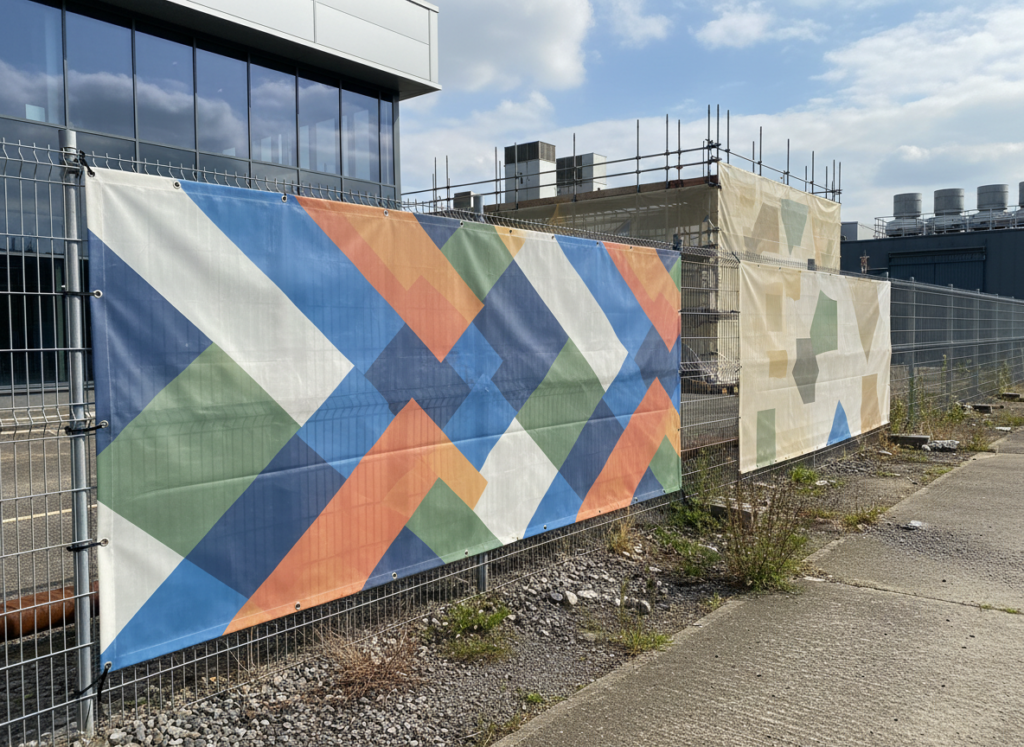
Mesh banner material has a perforated or open-weave construction that allows air to pass through it. This reduces the wind loading on the banner significantly compared to solid PVC.
Why wind matters for banners
A solid PVC banner in a fully exposed outdoor location acts like a sail. In strong wind, it puts enormous tension on its fixings and support structure. If the banner is attached to scaffolding, a fence or a frame that is not rated for that load, something will give — either the banner tears, the eyelets pull through, or the structure itself is damaged.
Mesh material reduces this risk substantially. Because air can pass through the banner, the effective wind load is much lower. This makes it a safer and more practical choice for large formats in exposed locations.
What mesh banners are good for
Print quality on mesh
Because mesh material is perforated, the print sits on the solid parts of the weave and the open spaces read as part of the overall image from a distance. At viewing distances of a few metres, the image reads as a continuous graphic. Close up, the perforation is visible. For most outdoor banner applications where viewers are several metres away, this is not a problem. If you need close-up print quality for a display people will examine at arm’s length, PVC or fabric is a better choice.
Scaffolding banners: If you are wrapping a scaffolding structure, mesh is almost always the correct choice. Using solid PVC on scaffolding in exposed conditions can create dangerous wind loads that the scaffolding is not designed to handle.
Fabric Banners
Fabric banners are printed on textile materials rather than PVC. The most common type used in display and event settings is a lightweight woven polyester fabric, sometimes described as display fabric, pop-up fabric or tension fabric.
How fabric banners differ from PVC
Fabric gives a softer, more textile feel compared to the harder surface of PVC. It can be folded without creasing permanently, which makes it easier to transport and store. It is typically lighter in weight, which matters for hanging displays, pull-up systems and exhibition displays where the structure has a weight limit.
Fabric is also commonly used with tension display systems — frameworks that hold the fabric under tension to create a taut, smooth display surface without visible fixings. These systems are popular in exhibition and retail environments.
What fabric banners are good for
Is fabric suitable for outdoor use?
Most display fabric is not designed for long-term outdoor exposure. Rain, UV and temperature changes degrade it faster than PVC, and it can become heavy and difficult to manage when wet. There are outdoor-rated fabric materials available, but for most standard outdoor banner applications, PVC or mesh will give better results and longer service life. If you are not sure which is appropriate for your intended location, it is worth asking your print supplier before committing.
Comparing the Three Options Side by Side
PVC Banner
Mesh Banner
Fabric Banner
Other Banner Considerations
Single-sided vs double-sided
Most PVC banners are single-sided — printed on one face only. If your banner will be visible from both sides (suspended across a street, hanging from a ceiling, attached to a gate), you can specify double-sided printing or order two banners back-to-back. Some premium PVC materials are designed specifically for double-sided print with a black-out layer that prevents show-through.
Size and aspect ratio
Banner printing is produced to custom sizes. There are no standard fixed dimensions, although common formats include 6ft x 2ft, 8ft x 3ft and various wide-format options for events and hoardings. Your design should be supplied at the correct aspect ratio and at an appropriate resolution for the print size. For most outdoor banners viewed at a distance of three metres or more, 72dpi at full size is a common minimum. Consult your printer’s artwork specifications before finalising your design.
How to fix and install your banner
Eyelets are the standard fixing method for PVC and mesh banners. Bungee cords, cable ties and rope are all commonly used. For tension fabric displays, the fabric is fitted to a specific frame system rather than fixed with eyelets. Make sure you know how your banner will be fixed before you finalise the size and specify the eyelet positions.
Artwork tip: Leave a clear border of at least 50mm around all printed edges if your banner will be hemmed and eyeleted. Any text or key design elements within this margin may be partially obscured by the hem or blocked by the eyelet.
Banner Care and Longevity
A well-made PVC banner in a sheltered outdoor position, properly fixed and maintained, can last two to three years before the print starts to degrade noticeably. In more exposed conditions, expect a shorter lifespan. Mesh banners in scaffolding applications often last a full construction project duration — typically months — before being removed.
Fabric display banners can be reused many times if they are stored correctly between uses. Folding rather than rolling and keeping them in a protective bag or carry case extends their life considerably.
If a banner develops a small tear, it can sometimes be repaired with banner tape as a temporary fix, but a replacement is usually the better long-term answer for anything customer-facing.
Frequently Asked Questions
What is the standard material for a printed banner?
For most outdoor applications, 440gsm or 510gsm PVC is the standard starting point. It handles weather well, accepts print accurately and is cost-effective for standard display sizes. Mesh is specified for exposed or scaffolding locations where wind loading is a concern.
How long does a PVC banner last outdoors?
In a partially sheltered outdoor position, a well-made 440–510gsm PVC banner typically lasts one to three years before print or material degradation becomes visible. Direct sun, coastal exposure and poor installation all reduce this significantly.
Can banners be double-sided?
Yes. Specify this when ordering. Some standard PVC allows light show-through if you simply print both sides, so for premium double-sided work, a blackout layer is used between the two print faces. Your printer will advise on the right approach for your application.
Do I need to supply a specific file format for banner printing?
PDF or high-resolution JPG at the correct dimensions is standard. Vector artwork (AI or EPS) is ideal for designs with solid colours or text. Check your printer’s artwork requirements before you supply files — particularly around bleed, border and resolution.
Can you help with artwork for a banner?
Yes. If you have a logo and some text and need help laying it out for print, get in touch via our contact page or call 01773 608071 and we can talk through what you need.
Need a Printed Banner?
We produce PVC, mesh and fabric banners from our workshop in Somercotes, Alfreton. Whether you have a finished design ready to print or need help working out what material and size will work for your location, we are happy to help.
For builders and contractors needing large printed site banners, our guide to scaffold banners and printed site boards in Derby covers sizes, mesh vs PVC, planning rules and pricing for construction projects across Derbyshire.