
Printscene — Somercotes, Alfreton, Derbyshire
Branded Workwear for Tradespeople: What to Order and How to Get the Best Results
Whether you are a sole trader or running a team, branded workwear does more than make you look professional. It puts your name in front of customers every time you are on site — and that adds up over a working week.

Written by Printscene
- Branded Workwear
- Tradespeople
- Printed Clothing
Why Branded Workwear Matters for Trades Businesses
When you turn up to a job in plain clothes, you are a face. When you arrive in branded workwear with your company name, number and logo clearly visible, you are a business — and that distinction matters to customers.
Homeowners and commercial clients make judgements quickly. A tradesperson who looks the part inspires more confidence than one who does not. That confidence translates into trust, higher perceived value and more willingness to refer you to others.
Branded clothing also makes your team easier to identify on a shared site. If customers can see who is from your business at a glance, they are more likely to approach your staff directly — and that means more opportunities to make a good impression.
Which Garments Work Best for Trades?
Polo shirts
The most popular choice across nearly every trade. Polo shirts are smart enough to make a good impression at an initial consultation but practical enough for a day’s work. They take embroidered logos well — particularly on the chest or sleeve — and they are available in a wide range of colours.
Most trades businesses choose a single colour (often navy, black or grey) and have their logo embroidered on the left chest. Some add the company name and number on the back for maximum visibility when working on site.
T-shirts
A step down in formality from polos, but popular for physical trades like construction, roofing and groundworks where comfort in warm weather matters more than appearance. Printed t-shirts can carry large back prints with strong brand impact at a lower cost per unit than embroidery.
If you want the company name running large across the back, a printed t-shirt is often the most cost-effective way to achieve it.
Fleeces and sweatshirts
Essential for outdoor trades in autumn and winter. Embroidered fleeces and sweatshirts maintain a professional look while providing practical warmth. They are also useful for client-facing situations when a t-shirt would look too casual.
Hi-vis vests and jackets
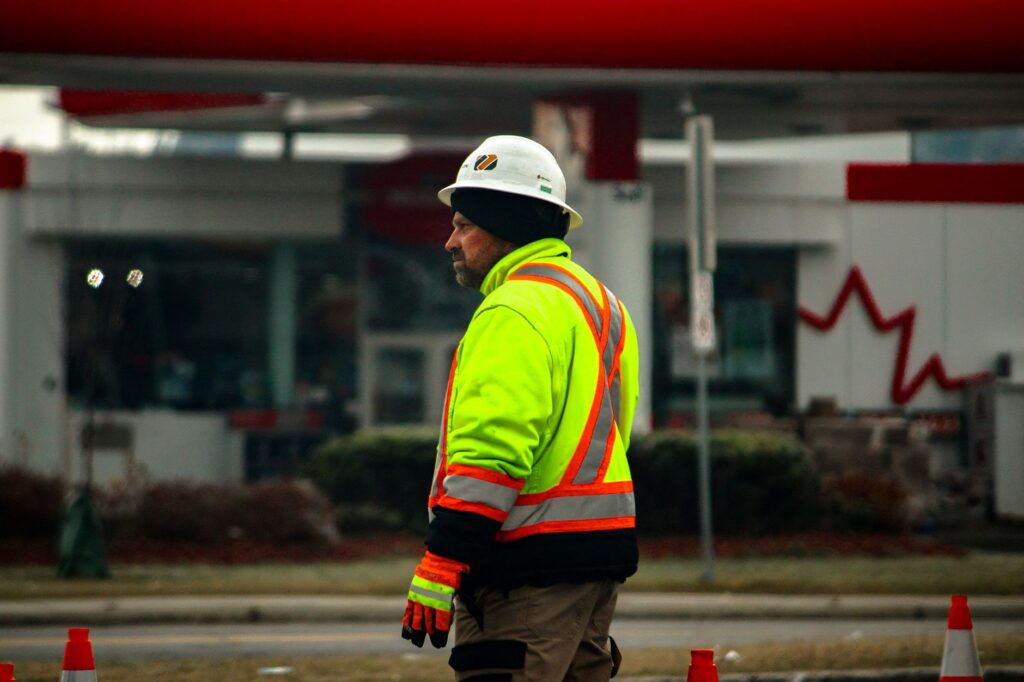
If your work takes place near traffic, on construction sites or in any environment where visibility requirements apply, branded hi-vis is a practical necessity. Your logo can be printed or embroidered onto hi-vis garments, combining legal compliance with brand visibility. Many trades businesses add their company name and number to the back of hi-vis vests so they are readable at a distance.
Waterproof jackets
For roofers, landscapers and groundworkers, a branded waterproof jacket is worth considering. The embroidery position is typically the left chest, though some businesses add a large printed panel to the back for impact when working outside.
Work trousers
Less commonly branded, but adding a small embroidered logo or company name to work trousers is possible and adds consistency to the overall uniform. More practical for businesses where a fully matched look matters, such as facilities management or commercial cleaning.
Printing vs Embroidery: Which Is Right for Workwear?
Embroidery
Embroidery is stitched directly into the fabric using thread. It produces a raised, textured finish that looks premium and professional, and it is extremely durable — embroidered logos can outlast the garment itself. It is the standard choice for polo shirt chest logos, fleeces and sweatshirts.
The main limitation of embroidery is that fine detail and gradients do not translate well. Complex logos with thin lines, small text or photographic elements may need to be simplified for embroidery. Your printer should advise you on this before you commit to an order.
Direct-to-film (DTF) printing
DTF printing transfers a printed film directly onto the garment. It handles full-colour designs, fine detail and gradients better than embroidery, and it works on a wider range of fabrics including hi-vis. It is also typically less expensive per unit for larger prints.
DTF is a good choice for back prints, full-colour logos that would not work in embroidery, or t-shirts where cost per unit matters.
A practical rule of thumb
Use embroidery for chest logos on polo shirts, fleeces and sweatshirts where the premium finish adds perceived value. Use DTF printing for large back prints, hi-vis garments and any design with gradients or fine colour detail that would not survive the stitch-count limitations of embroidery.
What to Put on Your Workwear
Less is usually more when it comes to workwear branding. The goal is to be clearly identifiable, not to turn your clothing into a full advertisement. Most trades businesses include:
The back of a garment is prime space for larger information — particularly useful on hi-vis or t-shirts where readability at a distance matters. If someone is photographing your team at work, the back of their clothing is often what is visible in the frame.
How Many to Order?
Most branded workwear is priced on volume — the more you order, the lower the cost per unit. That said, there is no minimum quantity that makes sense for every business. A sole trader might order five polo shirts. A team of ten might order fifty garments across multiple styles.
A practical starting point is to order enough for each team member to have two or three of the key garment (typically a polo shirt or t-shirt) plus seasonal extras like fleeces or hi-vis as needed. This gives you enough rotation to keep everything presentable without overspending on stock you do not need immediately.
Consider ordering a small additional quantity for new starters or replacements, particularly if your logo design and colour choice is stable. Running out of branded workwear and sending someone out in plain clothing undermines the consistency you have worked to build.
Getting Your Artwork Ready
The quality of your finished workwear depends significantly on the quality of the artwork you provide. For embroidery, a vector file (AI, EPS or SVG) is ideal. For DTF printing, a high-resolution PNG with a transparent background works well.
If you only have a low-resolution version of your logo, a good print company can usually work with you to create a usable version. At Printscene, we handle artwork preparation in-house — if you are not sure whether your file is suitable, bring it to us and we will let you know what is needed before any cost is committed.
It is also worth checking how your logo looks in a single colour before you order. Many embroidery processes work with a limited number of thread colours, and if your branding depends on a gradient or a complex colour palette, you may need to agree on a simplified version for workwear use.
Frequently Asked Questions
What is the minimum order for branded workwear?
It depends on the supplier and the decoration method. Embroidery often works from a single garment upward, though the cost per unit is lower at higher quantities. Print methods may have slightly higher minimums. Talk to your supplier about your specific requirements and they can advise on the most cost-effective approach.
How long does branded workwear take to produce?
A typical order takes one to two weeks from artwork approval to delivery. If you need garments urgently, speak to your supplier early — rush production is sometimes possible but may carry a premium, so it is worth planning ahead where you can.
Can I wash branded workwear in a normal machine?
Yes. Both embroidered and DTF-printed garments are designed to withstand regular machine washing at normal temperatures. Turn garments inside out before washing to extend the life of prints, and avoid tumble drying at high heat where possible.
What colours work best for trades workwear?
Navy, black, grey and dark green are the most popular choices for trades businesses. They hide everyday dirt and general wear far better than light colours, while still looking professional and consistent on site. Your logo will usually stand out more clearly against a dark base too.
Can I order workwear for a mix of garment types in one go?
Yes. It is common to combine polo shirts, fleeces, t-shirts and hi-vis in a single order. Your supplier can advise on the most cost-effective approach, particularly if different decoration methods are needed for different garment types within the same order.
Ready to get your team looking the part?
Printscene produces branded workwear for trades businesses across Derbyshire and beyond — polo shirts, fleeces, hi-vis vests, t-shirts and more. Get in touch and tell us what you need.