
Printscene — Somercotes, Alfreton, Derbyshire
Roller Banners Explained: Types, Uses and Design
Roller banners are one of the most practical display tools a business can own. Whether you’re exhibiting at a trade show, setting up a pop-up or presenting at a conference, a well-designed roller banner does a lot of the heavy lifting. This guide covers what they are, which sizes to choose, how to design them for impact, and when they’re the right tool for the job.

Written by Printscene
- Roller Banners
- Pull-Up Banners
- Exhibition Displays
- Derbyshire
What Is a Roller Banner?
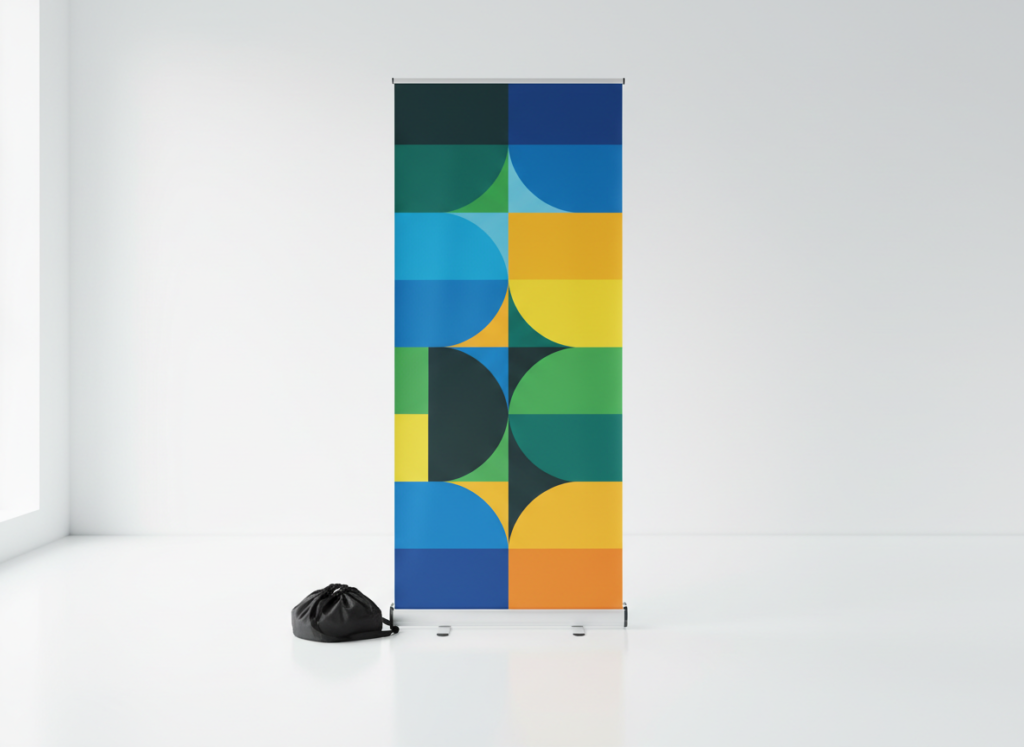
A roller banner — also called a pull-up banner or retractable banner — is a freestanding display unit where the printed graphic is housed in a base unit and pulled upright on a support pole. When you need it, you extend the pole and pull the print up into place. When you’re done, it rolls back into the base and packs away into a carry bag.
The appeal is practical: they’re quick to set up, easy to transport, and they make a strong visual impression without any specialist installation. Most roller banners weigh between 3kg and 5kg, and one person can have a banner standing in under a minute.
They’re used at exhibitions, in reception areas, at conferences and events, in retail environments and as temporary point-of-sale displays. Because they’re freestanding and require no fixings, they work in spaces where you can’t attach anything to the walls.
Roller Banner Sizes: Which One to Choose
Most roller banners are around 2000mm tall. The main variation is in width, and that choice affects how the banner sits in a space, how easy it is to design, and how much visual presence it gives you. For a fuller breakdown of each width and how to pick one for your venue, see our roller banner size guide.
Standard Width Options
Not sure which size to go for? If this is your first roller banner, 800mm x 2000mm is the standard. It fits most event spaces, is easy to find carry bags and replacement graphics for, and is what most designers are used to working with.
Shorter Height Formats
While 2000mm is standard, shorter versions at around 1500mm or 1600mm are also available. These suit tabletop displays, indoor spaces with low ceilings, or situations where you want a display that sits at eye level rather than towering over visitors. They’re less commonly used but worth asking about if your space has restrictions.
Artwork Size, Visible Height and the Hidden Cassette Zone
Supply roller banner artwork at the finished banner size — 800 x 2000mm, 850 x 2000mm, 1000 x 2000mm or 1200 x 2000mm. Between roughly 70mm and 150mm at the bottom of that graphic rolls into the base cassette and is never seen on display, so keep logos, phone numbers and web addresses well clear of it.
| Banner width | Artwork size to supply |
|---|---|
| 800mm | 800 x 2000mm |
| 850mm | 850 x 2000mm |
| 1000mm | 1000 x 2000mm |
| 1200mm | 1200 x 2000mm |
How much disappears into the cassette varies by model, so check the template for the stand you are actually ordering before you finalise the layout. The other measurement worth knowing is assembled height: a standard roller banner stands at roughly 2050–2150mm once the pole is in, a little taller than the 2000mm graphic. Most hotels, conference centres and exhibition halls cap displays at 2.5 metres, so a standard unit sits comfortably inside that — but it is worth confirming with the venue if you are ordering a taller or wider format.
Where Roller Banners Work Best
Part of what makes roller banners so useful is how adaptable they are. Here are the situations where they tend to deliver best.
Trade Shows and Exhibitions
Roller banners are a staple at exhibitions. They set up in seconds, don’t need fixing to walls, and roll away neatly at the end of the day. A pair of banners either side of a stand creates a professional branded backdrop without any specialist installation effort.
Reception Areas and Offices
A roller banner in a waiting area communicates services, values or key messages to visitors while they wait. Unlike wall graphics, a banner can be moved around easily and updated when your messaging changes — no building work involved.
Retail and Point of Sale
In shops and showrooms, roller banners draw attention to promotions, seasonal offers or product categories. They’re effective near the entrance or at point-of-sale positions where footfall is highest and attention is easiest to capture.
Conferences and Presentations
A well-designed banner behind a speaker reinforces brand identity throughout a session. It adds a professional backdrop without any extra work on the day, and it packs away quickly once you’re done.
How to Design a Roller Banner That Gets Noticed
Roller banners are viewed from a distance, so design decisions matter more than many people expect. Getting the layout right from the start means you won’t be reprinting a few months later because something important is unreadable or in the wrong place.
Put Key Information at the Top
Most people’s gaze will land on the top half of a banner before anything else. Your logo, headline or most important message should sit in roughly the top 800–1000mm of the design. Supporting information — contact details, secondary services, a tagline — can sit lower down, but anything critical should be above mid-height.
Keep Text Large Enough to Read From a Distance
Banners are usually viewed from at least 2–3 metres away. Text that looks clear on screen can disappear at that distance if it’s too small. As a rough guide, body text should be at least 30pt at full print size, and headlines should be considerably larger. When in doubt, go bigger.
Use High-Resolution Images or Vector Graphics
Low-resolution images look blurred when printed at banner size. Use images at 150dpi at the full print dimensions, or work with vector files (EPS, AI, SVG) wherever possible — especially for logos. A good printer will check your files before going to press and flag anything that looks too low in resolution to print cleanly.
Allow Bleed at the Edges
Most printers ask for 3mm or more of bleed at the edges of the artwork to account for any slight variation during finishing. Keep important content — particularly text and logos — within the safe area, clear of the edges, so nothing gets trimmed off in production.
Need help with artwork? Printscene checks all files before printing. If your artwork has any issues, we’ll let you know before anything goes to press. Get in touch for a friendly quote or to talk through your artwork requirements.
Economy vs Premium Roller Banners
Not all roller banners are built the same. The base unit, graphic material and print quality all affect how the finished product looks and how long it holds up in regular use.
Economy Units
Economy roller banners are cost-effective and perfectly suitable for one-off events, temporary promotions or situations where the banner will only be used a handful of times. The retraction mechanism and base are lighter, which means they can show wear more quickly under heavy use.
Premium Units
Premium roller banners have more stable bases, stronger poles and better retraction mechanisms. They stand up to repeated use and look the part in high-footfall areas like reception desks or flagship retail locations. If you’re using the same banner week after week, a premium base is worth the extra investment.
Single-Sided vs Double-Sided
Standard roller banners print on one side only. Double-sided units are available and work well when your display will be seen from both directions — at an entrance, in the middle of a room, or in any position where people approach from both sides.
Replaceable Graphic Cassettes
Some premium base units allow you to replace just the graphic cassette rather than the whole banner. If you update your branding or messaging regularly, this can reduce the cost of keeping your displays current over time. It’s worth asking about this option when you’re choosing a unit.
Roller Banners vs Other Banner Types
Roller banners are just one type of banner display. It helps to know how they compare to other formats so you can choose the right option for your situation.
For most small and medium-sized businesses, roller banners hit the right balance of price, practicality and visual impact. You can find out more about banner printing options at Printscene.
How Many Roller Banners Do You Need?
This depends on what you’re trying to achieve and the size of the space you’re working in.
For a basic event or exhibition stand, one or two banners positioned either side of your table or display creates a branded backdrop and helps visitors find you. For a larger exhibition stand, three or four banners used in a row can create a continuous backdrop across the full width of the space — popular with businesses attending larger trade shows.
For a permanent reception or office display, one well-designed banner that reflects your current brand messaging is usually the right call. The important thing is to update it when your messaging or services change, rather than leaving an outdated design in place for years.
If you’re not sure how many you need, think about the number of different messages you want to convey, the physical size of the space, and whether you need the banners to work in multiple locations on different occasions.
Frequently Asked Questions
How long does a roller banner last?
With reasonable care, a quality roller banner can last several years. The retraction mechanism is the main point of wear, so avoid pulling the graphic back under tension or forcing it if it sticks. Economy banners are designed for lighter or shorter-term use; premium units handle regular use much better.
What file format should I send for roller banner printing?
A high-quality PDF at the full print size, with bleed and embedded fonts, is the standard for most printers. If you’re working with a designer, ask them to set up the document to the exact print dimensions. Printscene can advise on specific file requirements when you get in touch for a quote.
Can I use a roller banner outdoors?
Standard roller banners are designed for indoor use. The base units are not weighted for outdoor conditions and the graphic substrate isn’t typically weatherproofed. For outdoor use, a flat vinyl banner or a weighted feather flag is a more appropriate option. Printscene can advise on outdoor banner options.
Can I just replace the graphic without buying a new base?
On some premium base units, yes — the graphic cassette can be swapped without replacing the whole stand. This is worth asking about if you update your branding or seasonal messaging regularly, as it can reduce costs over time.
Need a Roller Banner for Your Business?
Printscene prints roller banners from our Alfreton workshop. We check your artwork before we print and can advise on sizes, materials and setup if you need a hand before ordering.