
Printscene — Somercotes, Alfreton, Derbyshire
Safety Signs for Business: What Your Workplace Needs and Why
Most businesses need safety signs. The types required depend on the layout, activities and potential hazards within your premises.

Written by Printscene
- Mandatory signs
- Prohibition signs
- Warning signs
- Safe condition signs
This guide explains the four main categories of safety sign used in UK workplaces, what each one communicates, and how to work out which ones apply to your business — without overcrowding your walls with signs that are not necessary.
Why safety signs matter in UK workplaces
The Health and Safety (Safety Signs and Signals) Regulations 1996 require employers to use safety signs where significant risks cannot be adequately controlled by other means. This covers most commercial premises, workshops, warehouses, construction sites and public-facing businesses.
The regulations follow European standards, which means safety signs in the UK use specific colours and shapes to communicate meaning at a glance — even when people do not share the same language.
Failure to display required signs is not just a compliance issue. In the event of an accident or inspection, missing signage can create serious legal and liability problems for a business.
Safety signs are a legal requirement, not just a good idea. If you are setting up a new premises or reviewing your existing signage, it is worth doing a proper walk-through to identify what is needed before an inspection or incident forces the issue.
The four main categories of safety sign
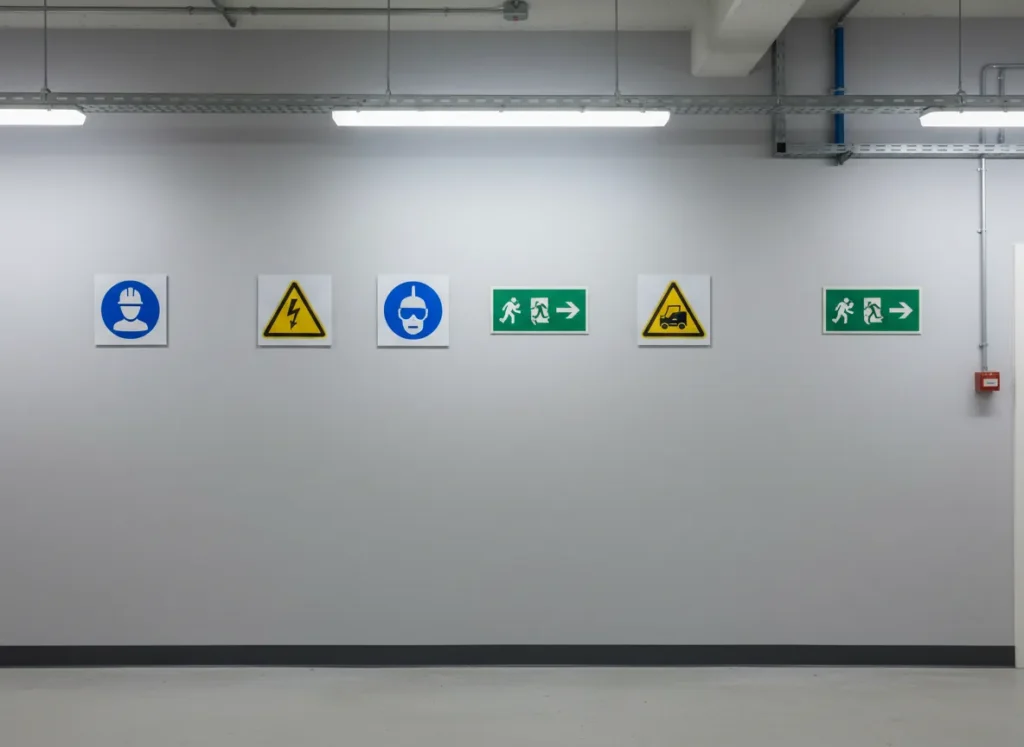
UK safety signs follow a colour and shape system that makes their meaning clear without requiring text. Here is what each category covers:
Prohibition signs (red and white, circular)
These tell people what they must NOT do. A red circle with a diagonal line across an image is the standard format.
Mandatory signs (blue and white, circular)
These tell people what they MUST do. Blue circular signs indicate a positive instruction that must be followed.
Warning signs (yellow/amber and black, triangular)
These alert people to a hazard. The yellow triangle with a black border and symbol is one of the most recognised safety formats in the world.
Safe condition signs (green and white, square or rectangular)
These indicate the location of safety equipment or emergency exits. Green signs show where help, safety or escape can be found.
A fifth category — fire safety signs — uses a red background and is specifically for fire-fighting equipment such as extinguishers and hose reels. These are sometimes grouped with safe condition signs but have their own standard under fire safety regulations.
Which safety signs does your business actually need?
There is no universal list that applies to every business. The signs you need depend on the specific activities, equipment and hazards present on your premises. That said, some signs apply to almost every commercial and public-facing workplace.
Signs needed by most businesses
Signs needed in warehouses, workshops and trade premises
Signs needed in food preparation and catering environments
Signs needed in public-facing retail or office premises
Material and size: what matters for safety signs
Safety signs need to be visible and durable for the environment they are placed in. The right material depends on whether the sign is indoors or outdoors, and how much wear it is likely to face.
Rigid plastic or aluminium signs
The most common material for fixed safety signs. Rigid signs are long-lasting, easy to wipe clean and suitable for most indoor wall-mounted applications. Aluminium composite signs add extra durability and weather resistance for outdoor use.
Self-adhesive vinyl signs
Vinyl signs can be applied directly to walls, machinery or equipment. They are cost-effective for lower-traffic areas and useful where a rigid panel cannot easily be fixed. Not ideal for high-wear or frequently handled surfaces.
Sign size and visibility
The 1996 Regulations do not specify exact sign dimensions but state that signs must be visible and legible from the relevant position. As a general rule, the further away the viewer is expected to be, the larger the sign needs to be. A fire exit sign above a doorway needs to be readable from across a room; a mandatory PPE sign at a door threshold can be smaller.
If you are unsure what size is appropriate for a specific location, tell us where the sign will go and the approximate viewing distance when you get in touch. We can advise on the right size for clear visibility.
Custom safety signage: when you need something specific
Standard safety signs cover most common workplace situations, but many businesses also need signs that combine safety messaging with their own specific rules, layouts or branding.
Examples where custom safety signs are useful:
Printscene can print custom safety signage to your exact requirements — from one-off signs to a full set for a new premises or site. We work from your artwork or can help you set up the layout if needed.
How often should safety signs be replaced?
There is no fixed legal interval for replacing safety signs, but they should be replaced when they are no longer clearly visible and legible. Common reasons for replacement include:
A quick walk-through of your premises once or twice a year is enough to catch most sign maintenance issues before they become a problem during an inspection.
Safety signage at Printscene
We print and supply safety signs for businesses across Derbyshire and the surrounding area from our workshop in Somercotes, Alfreton.
Whether you need a single replacement sign or a full set for a new site, we can help with standard safety sign formats and custom-printed signage to your specification. Orders can be collected from Victoria Street, Somercotes or we can arrange delivery.
If you are unsure what you need, get in touch and we can talk through the requirements for your specific type of premises.
Frequently asked questions
Are safety signs a legal requirement in the UK?
Yes. The Health and Safety (Safety Signs and Signals) Regulations 1996 require employers to use safety signs where significant hazards exist and cannot be adequately controlled through other means. Fire exit and first aid signage are required in virtually all commercial premises.
What colour is a mandatory sign?
Mandatory signs are blue and white, circular in shape. They indicate an action that must be taken — such as wearing PPE or washing hands.
What is the difference between a warning sign and a prohibition sign?
Warning signs (yellow triangles) highlight the presence of a hazard. Prohibition signs (red circles with a diagonal line) tell people what they must not do in a specific area. Both communicate risk but in different ways.
Can I get safety signs made to a custom size?
Yes. We can print safety signs at custom dimensions to suit your specific location and viewing requirements. Get in touch with your requirements and we will advise on what works best.
Do you supply both rigid and self-adhesive safety signs?
Yes. We can produce safety signs on rigid substrates (suitable for wall mounting) or as self-adhesive vinyl (for direct application to surfaces or machinery). Talk to us about the right option for your environment.
Need safety signs for your business?
We supply standard and custom safety signage from our Somercotes workshop. Local collection available or delivery across Derbyshire. Call us on 01773 608071 or get in touch online.
related-guides
Related guides