
Printscene — Somercotes, Alfreton, Derbyshire
A-Board Signs for Business: When, Where and How to Use Them
A-boards — also known as sandwich board signs or pavement signs — are one of the simplest and most cost-effective forms of outdoor signage available to businesses. Used well, they attract footfall, communicate offers, and make your premises easier to find. Used poorly, they blend into the background and achieve nothing.

Reviewed and signed off by Printscene
- A-board signs
- Pavement signs
- Outdoor marketing
- Business signage
What Is an A-Board Sign?
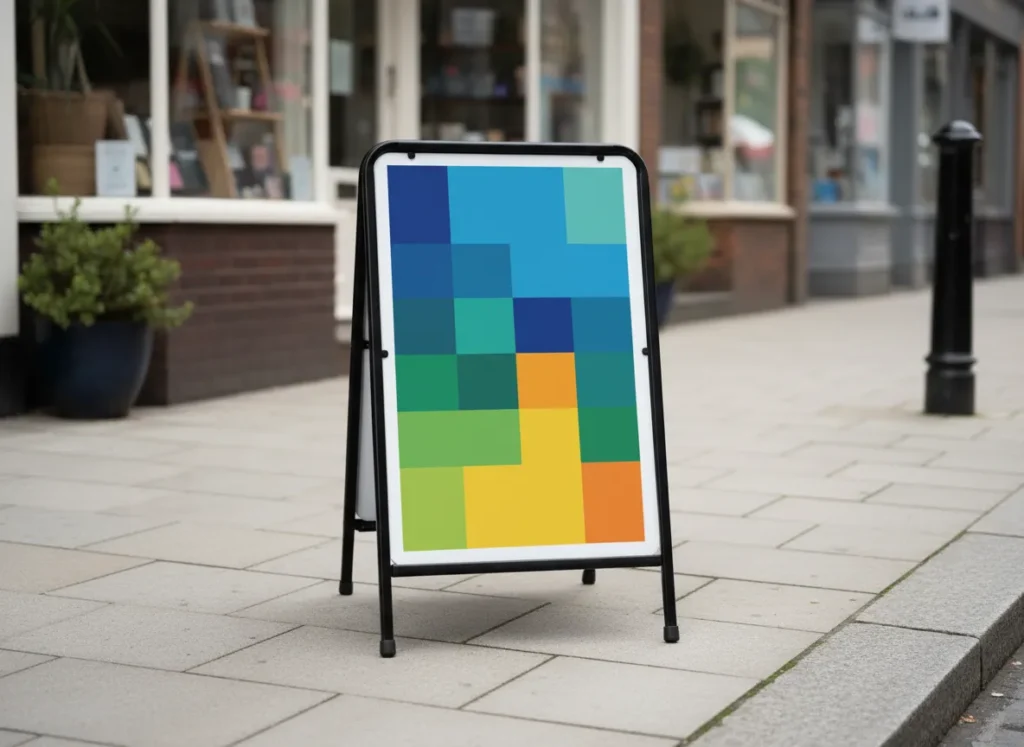
An A-board is a freestanding double-sided sign in an A-frame shape. It sits on the pavement or ground outside a business, usually at the entrance or nearby, and carries a printed or written message visible to passing pedestrians and drivers.
The name comes from the shape: two panels hinged at the top form an A when viewed from the side. Most A-boards are designed to be easy to move, store, and change the messaging on — making them one of the most flexible bits of signage a business can own.
They are used by cafés, restaurants, retailers, salons, garages, gyms, and almost any business with a physical premises that wants to reach people passing by.
Why A-Boards Work
At their most basic, A-boards work because they intercept people who are already nearby. Someone walking past your premises who might not have noticed it, or who was not specifically looking for you, can be caught by a well-placed A-board with a clear message.
That interception is valuable. It costs nothing per impression once the board is made and placed. And unlike digital advertising, it works passively — you do not need to manage it daily, adjust a budget, or monitor performance data.
They work for businesses with passing trade
A-boards are most effective when there is a reasonable volume of foot traffic nearby. High streets, market towns, shopping areas, business parks with footfall, or premises near car parks and transport links all benefit. If your location is off the beaten track with limited passing trade, an A-board will do less work — but it can still help guide customers who are already looking for you.
They give you reactive flexibility
One of the practical advantages of a well-designed A-board is that the graphic panel or poster insert can often be swapped out. This means you can change your message seasonally, promote different offers at different times, or update information without replacing the whole board. That flexibility makes them good value over time.
Types of A-Board Signs
Not all A-boards are the same. The right type depends on your environment, how often you want to change the message, and how much weather exposure the board will face.
Printed panel A-boards
These have a fixed printed graphic inserted into the frame. The printing is done professionally, which means you get full colour, sharp graphics, and consistent branding. A printed panel looks more polished than a handwritten message and communicates a higher level of professionalism. It is well suited to businesses that want a consistent, branded look rather than frequently changing messages.
Snap frame A-boards
Snap frame A-boards have a frame on each face that opens to allow a printed poster or graphic to be inserted and changed easily. These are popular with businesses that want the option to update their messaging regularly — promotions, seasonal changes, event announcements — without needing a new board each time.
Chalkboard A-boards
Chalkboard or blackboard A-boards are a classic option, particularly for cafés, restaurants, and independent retailers. They allow you to write messages by hand and change them as often as you like. Done well, hand-lettered chalk signs have a character and warmth that printed signs can lack. Done poorly, they can look scrappy. If you use one, keep the writing neat and the message current.
Heavy-duty outdoor A-boards
Standard A-boards can be knocked over by wind or shifted by rain on uneven surfaces. Heavy-duty outdoor A-boards are built with more robust materials, wider bases, and sometimes water-fillable feet to keep them stable in exposed locations. If your A-board will be in a position with open exposure to weather, a sturdier option is worth the investment.
Good to know: If you plan to place an A-board on a public pavement, check your local council’s rules. Some local authorities require a permit for pavement signs, and there are usually requirements around how much of the pavement must remain clear for pedestrians. Getting this right avoids fines and keeps you on the right side of your local authority.
What to Put on an A-Board Sign
This is where many businesses go wrong. An A-board that tries to say too much says nothing. A passerby typically has two or three seconds to read your sign. You need to communicate the essential message in that time.
The one-message rule
Pick one thing your A-board is communicating today. Is it drawing attention to your premises? Promoting a specific product or deal? Announcing an event? Guiding people from a junction? One clear message, communicated simply, is far more effective than four competing messages crowded onto the same sign.
Keep the text short
Five to ten words is usually enough. “Fresh coffee and lunch — open now” is better than a paragraph explaining your full menu. “10% off all repairs this month” is better than a detailed list of every service you offer. The sign should create curiosity or prompt action, not replace a conversation.
Make it readable from a distance
Text needs to be large enough to be read at a meaningful distance — at least ten to fifteen metres for a pedestrian at walking pace. This usually means a headline font at A2 or A1 size. If someone needs to walk up close to read your sign, you have lost the battle before it started.
Use strong contrast
Dark text on a light background or light text on a dark background. Avoid pale text on a pale background or subtle colour combinations that look interesting on screen but disappear at a glance outdoors in variable light conditions.
Include a clear next step
Where do you want the reader to go? In the door? To call a number? To scan a QR code? Make the action obvious. Even something as simple as an arrow pointing towards your entrance can increase the number of people who follow through.
Placement: Getting the Most From Your A-Board
Where you put your A-board matters as much as what it says.
Near the decision point
The most valuable position for an A-board is where someone is about to decide whether to walk past or walk in. Just outside your door, or at the turning point on a street, gives the sign the best chance of influencing that decision. Too far from your premises and it loses its connection to the action you want people to take.
At a natural pause point
People who are already slowing down — waiting to cross a road, looking around a junction, checking their phone before they decide where to go — are more receptive to your message. If there is a crossing, a bus stop, or a natural gathering point near your premises, an A-board positioned nearby can catch people in that moment.
Where your premises are not obvious
If you are set back from the road, accessed through a car park, or located on a side street, an A-board at the main road can serve as a directional sign to guide people in. In this case, the message is simpler — your name, what you do, and an arrow pointing in the right direction.
Multiple boards along a route
Some businesses use two or three A-boards placed at intervals along a walking route to a premises that is not immediately visible. Each board builds the story — the first creates awareness, the second provides information, the third is right outside the door. This approach is used by businesses in market towns, business parks, and covered retail areas.
A-board signs: key points
Maintaining and Looking After Your A-Board
A-boards take a beating. They sit outdoors in all weathers, get knocked by bags and bikes, and are moved in and out regularly. A few habits keep them looking good for longer.
Bring your A-board in at the end of each day. Leaving it out overnight exposes it to conditions it was not designed for and significantly shortens its life. It also makes it a target for opportunistic movement or vandalism.
Keep the graphic clean. A grubby or faded insert undermines the message. If a snap-frame poster is looking worn, it is worth printing a fresh one — it is a low cost refresh that can make the whole board look new again.
Check the hinges and fixings periodically. Most A-boards have a chain or cord holding the two sides at the correct angle. Over time these can stretch or break. A board that has collapsed on itself or is leaning at an odd angle does more harm than good.
FAQs: A-Board Signs
How long does a printed A-board graphic last?
With normal outdoor use and daily storage indoors overnight, a good quality printed panel should last a year or more before fading or wear becomes noticeable. UV-resistant inks and laminated finishes extend this further.
Can A-boards be printed in full colour?
Yes. Most professional print suppliers produce full-colour A-board graphics and inserts. This gives you far more flexibility in how you present your brand and messaging than chalkboard or single-colour alternatives.
What size are standard A-boards?
The most common sizes for A-board inserts are A1 (594mm x 841mm) and A2 (420mm x 594mm). Some boards take a custom or non-standard size, so check the specifications of your specific board before ordering the print.
Do I need a permit to put an A-board on the pavement?
Rules vary by local authority. Many require a pavement licence or simply ask that a certain width of pavement remains clear. Check with your local council before placing any freestanding sign on a public pavement.
Can the printed inserts be replaced when I want to change the message?
Yes, with snap frame A-boards. The frame opens on each face to allow the printed insert to be swapped out easily. This makes snap frame boards a flexible long-term investment compared to fixed-panel alternatives.
Looking for A-board signs for your business?
Printscene designs and produces custom A-boards and pavement signs for businesses in Alfreton, Derbyshire and the surrounding area. Get in touch to discuss what you need.
Before setting up your board outside, it is also worth checking UK pavement rules for A-boards — particularly if your board will sit on public highway rather than your own private land.