
Printscene — Somercotes, Alfreton, Derbyshire
Embroidery vs Printing for Workwear: Which Is Right for Your Business?
When it comes to branded workwear, there are two main ways to apply your logo: embroidery and printing. Both are widely used, and both have situations where they clearly work better than the other. This guide explains the difference between the two methods, what each one suits, and how to make the right call for your business.

Reviewed and signed off by Printscene
- Embroidery vs Printing
- Branded Workwear
- Workwear Guide
- Derbyshire
What Is Embroidery on Workwear?
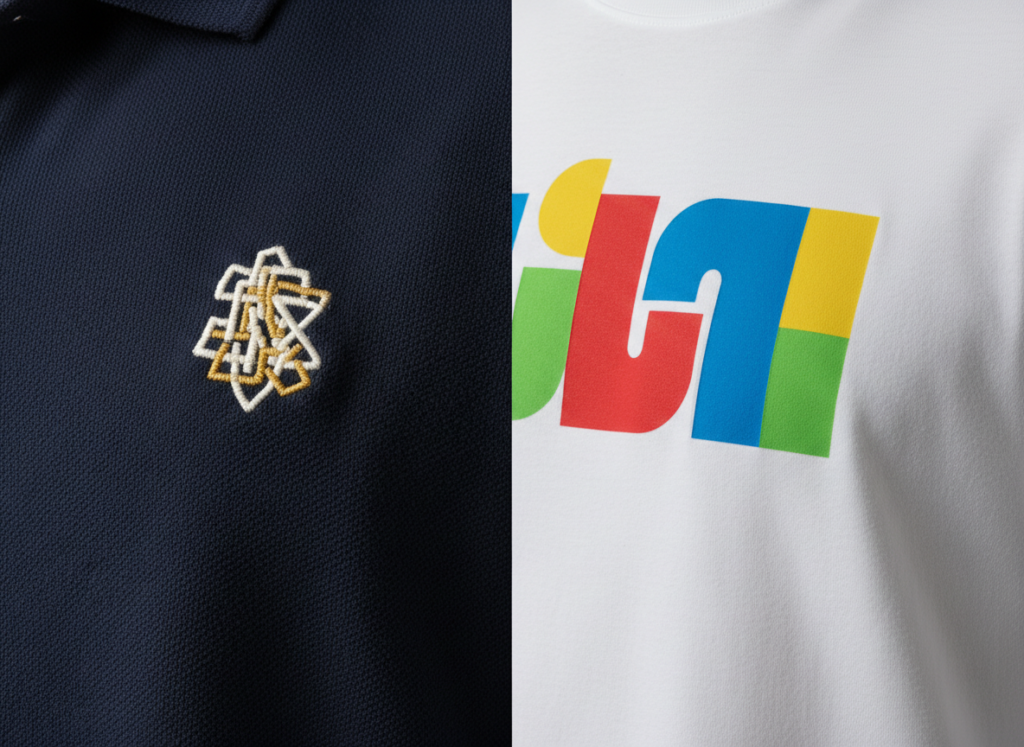
Embroidery uses thread stitched directly into the fabric of the garment. The design — usually a logo, monogram or simple artwork — is converted into a stitch file that an embroidery machine uses as a guide to reproduce the pattern in thread.
The result is a textured, raised design that sits within the fabric rather than on top of it. Embroidery is durable, looks professional in a traditional sense, and holds up extremely well through repeated washing and heavy use. It doesn’t peel, crack or fade the way some print methods can over time.
Embroidery works best with relatively simple designs — clean logos, wordmarks and standard shapes. Very fine detail, gradients and photographic imagery don’t translate well into thread.
What Is Printed Workwear?
Printed workwear applies your design onto the surface of the garment using ink or heat transfer. There are several print methods used in the workwear industry, the most common being screen printing and direct-to-garment (DTG) printing.
Screen printing uses stencils to apply layers of ink to the fabric. It’s cost-effective for larger runs of the same design and produces bold, consistent results. Colours are limited per print run — usually up to six — but within that constraint, the results are vivid and durable.
Direct-to-garment (DTG) printing works like a conventional inkjet printer but on fabric. It can reproduce complex artwork, photographs and multiple colours without stencils, which makes it suitable for detailed or photographic designs. It’s often used for smaller quantities where screen printing wouldn’t be cost-effective.
Both methods produce a flatter result than embroidery — the design sits on the surface of the fabric rather than being built up in thread.
Key Differences at a Glance
Embroidery
Printed
When Embroidery Is the Better Choice
Embroidery tends to suit businesses where the workwear needs to look smart and withstand hard daily use. Here are the situations where it’s usually the stronger option.
Professional or Customer-Facing Environments
In industries where staff appearance carries weight — hospitality, estate agencies, financial services, healthcare, facilities management — embroidered logos communicate a level of quality and care that printed alternatives sometimes don’t. The raised texture and thread finish reads as considered and premium in these settings.
Hard-Wearing Garments
Polo shirts, fleeces, softshell jackets and caps all take embroidery extremely well. These are garments that tend to be washed frequently and worn in demanding conditions. Embroidery outlasts most print methods on heavy-use garments because the thread is part of the fabric rather than sitting on top of it.
Clean, Simple Logos
If your logo is a clear wordmark, a simple icon or a two or three-colour design, it will convert cleanly into embroidery. The best embroidered logos tend to be bold and uncluttered. Thick fonts, solid shapes and clear edges all work well in thread.
Long-Term Uniform Programmes
For businesses that replace workwear regularly as part of a staff uniform programme, embroidery’s longevity means garments stay looking good for longer. The upfront cost per garment may be slightly higher than print, but the durability over the life of the garment is often worth it.
When Printing Is the Better Choice
Printed workwear suits different situations and different types of businesses. Here’s where it tends to come into its own.
Complex or Multi-Colour Artwork
If your branding includes gradients, photographs, detailed illustrations or a large number of colours, printing is the more practical choice. Embroidery can’t reproduce gradients or photographic detail — print can. Direct-to-garment printing in particular handles complex artwork well without the design needing to be simplified for the process.
Large Back Prints or Oversized Designs
Full-back prints, chest designs across the full width of a garment, or large-format artwork are much better suited to printing. Embroidery works best on relatively contained logo placements — chest left, sleeve, cap front. Covering the back of a t-shirt in embroidery would be extremely expensive and is rarely practical.
T-Shirts and Lighter Garments
Lightweight t-shirts and some casual garments take printing better than embroidery. Heavy embroidery on a thin t-shirt can affect how the fabric hangs and feel uncomfortable to wear. Screen printing or DTG keeps the garment light and flexible while still delivering a strong branded result.
Promotional or Event Clothing
For one-off events, trade shows, sponsored charity runs or seasonal promotions where the garments aren’t intended for years of daily use, printing is usually the more cost-effective option. The lower unit cost makes large promotional runs more accessible, and print quality is well-suited to short to medium-term use.
Not sure which method your garment suits? Both embroidery and printed workwear are available from Printscene and sister company TShapes, who specialise in garment ordering from the same Alfreton workshop. Get in touch and we can advise on the best option for your specific garment and logo.
Garment-by-Garment Guide
The garment type often influences which decoration method is most appropriate. Here’s a quick reference.
Cost Considerations
Both methods have different cost structures, and it’s worth understanding these before committing to a large order.
Embroidery Costs
Embroidery typically involves a one-off digitising cost to convert your logo into a stitch file, plus a per-garment cost based on the size of the design and the stitch count. The digitising cost is a fixed upfront expense, so the per-garment cost becomes more competitive as quantity increases.
Screen Printing Costs
Screen printing involves setup costs for each colour in the design, then a per-garment cost that falls as quantity increases. It’s most cost-effective for large runs of a single consistent design. Small quantities with multiple colours can work out more expensive than DTG.
DTG Printing Costs
Direct-to-garment printing has little to no setup cost and a consistent per-garment price regardless of design complexity. This makes it particularly well-suited to small orders or runs where the design varies between garments.
For a direct comparison on your specific order, the most reliable approach is to get a quote with the actual design, garment type and quantity you have in mind. The right method for your budget will be clear once you have comparable figures.
Frequently Asked Questions
Can I use both embroidery and printing on the same garment?
Yes — it’s common to combine methods. A typical example might be an embroidered chest logo (for a premium, durable branded feel) alongside a printed back design (for larger artwork or a tagline that works better as a flat print). Talk to your supplier about what’s practical for your specific garment.
How do I know if my logo is suitable for embroidery?
A logo that works well in embroidery tends to be bold, clear and relatively simple — a wordmark, a clean icon or a two or three-colour design. Fine lines, gradients and small text are harder to reproduce in thread and may need to be simplified. A digitising specialist will normally advise on any adjustments needed before creating the stitch file.
Does embroidery affect how the garment washes?
No — embroidery is extremely wash-stable. Follow the garment care instructions as normal. Embroidered designs are not affected by washing in the same way that some print methods can be if care instructions aren’t followed.
What file format do I need for embroidery or printing?
For both methods, a vector file (EPS, AI or SVG) of your logo is ideal, as it can be scaled without loss of quality. High-resolution PNG or PDF files also work in most cases. For embroidery, the file will be converted into a stitch file by the digitiser before production begins.
How many garments do I need to order?
Minimums vary by supplier and method. Embroidery and DTG printing can typically handle smaller quantities than screen printing, which is most cost-effective from around 10–12 garments upwards. Get in touch and we can advise on what makes sense for your order size.
Need Branded Workwear for Your Team?
Printscene offers embroidery and printed workwear from our Alfreton workshop. Our sister company TShapes also handles garment-focused orders with an easy online ordering route. Get in touch and we’ll help you find the right method for your logo, garments and budget.
Related: If you’re specifically looking for a local supplier, our guide to DTF printing near Derby covers the full process, materials and how to order direct to film transfers from our Somercotes workshop.